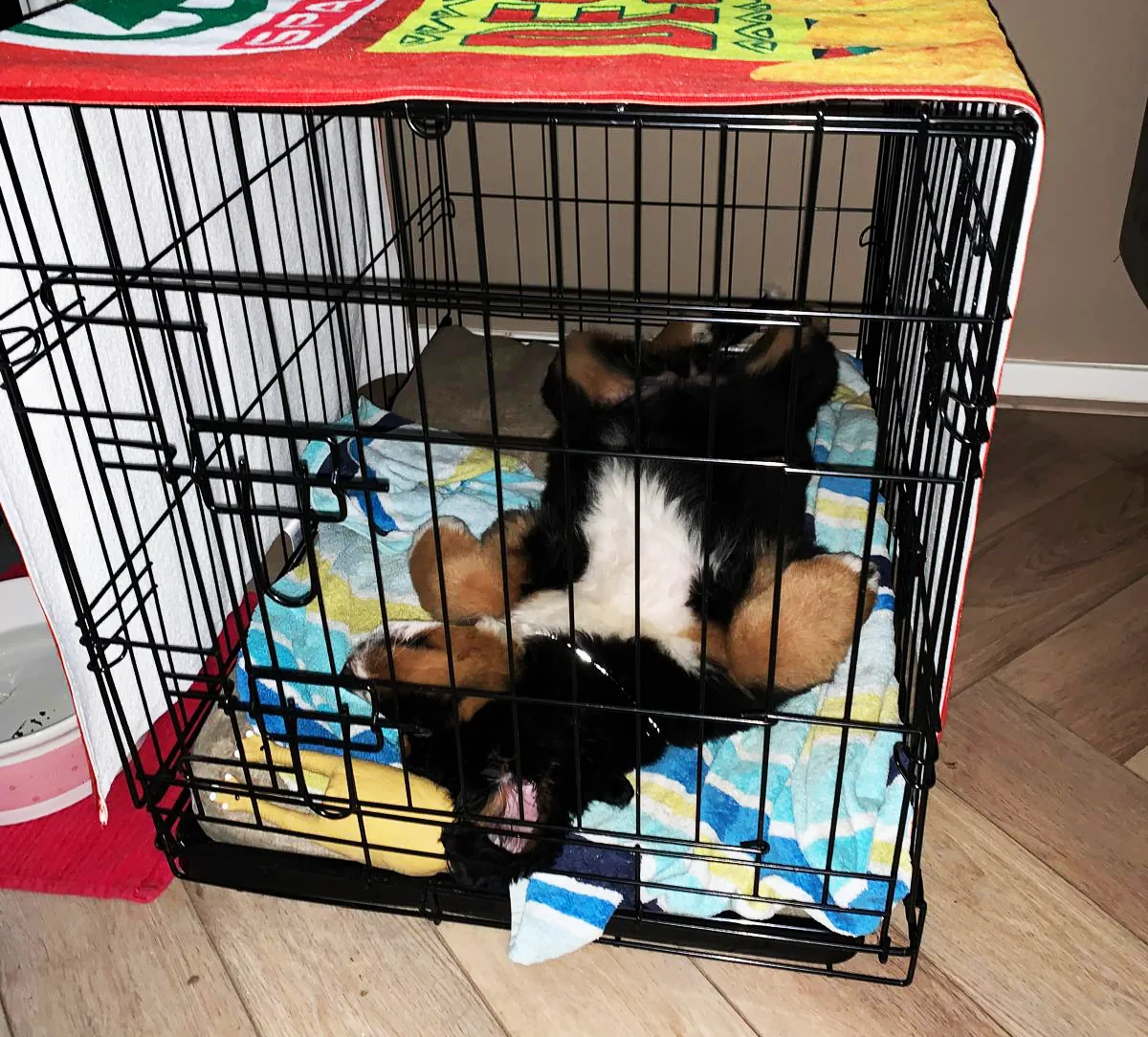
Not a puppy? With an older dog who does not know the crate, or one who has had a bad experience with it, this works against you. Start with Dog won't go in the crate.
The crate is part of the routine
With a puppy you do not have to start carefully. He sleeps in his crate from the very first night, and during the day he goes in regularly for a nap. That way the crate gets one clear meaning: this is where you sleep.
It only works if it is fixed into the day. A puppy who runs around loose all day and only has to go in at night never learns that difference. The crate is not a separate exercise, it is part of his rhythm.
Where the crate goes
In a quiet room, preferably one nobody walks through. You want nothing there to follow, because every movement and every sound is a reason for a puppy to stay awake.
Use a crate that closes, and put a blanket over it so it is dark. A dark, boring place is exactly what you want: there is nothing going on, so you may as well sleep.
The first nights
There is a good chance he will cry. That comes with it, and it says less than you think. Listen for the pauses above all: if there is space between the crying, there is no panic. He is calling you. He does not want to be alone and is trying to get to you.
Being alone is something he still has to learn. And he does not learn it if you come the moment he makes a sound, because then you teach him the opposite: crying works, it brings you here.
So you do not go over during the crying to reassure him. You only go to him when you are actually going to get him out, and even then only at a moment when he is quiet. If you hear him wake up and cry in the morning, wait until it is calm and only then walk into the room.
Count on it taking a while the first few times. An hour of crying with pauses in between is not strange. In the end he falls asleep, and every time the wait until that moment gets shorter.
If there are pauses between the crying, your puppy can still calm himself down and it is a matter of time. If there is not a single pause in half an hour, it is no longer calling but real panic, and he will not get out of that on his own. Stop then, and make the crate better first.
Coming out is training too
Do not just open the door and let him bounce out. Then every rest ends in excitement, and that is the last thing you want attached to it.
Have him sit or lie down and open the door. If he gets up or gets restless, close it again. Repeat that until he stays put while it is open, and only then give your word that he may come out. A fine impulse-control exercise, without having to make a separate exercise out of it.
Do not make a fuss when you get him out either. If you turn it into a party, you confirm that something special is happening and the crate becomes a place to be rescued from. It should be ordinary.
Make the crate worth it
Throw treats in through the day, without saying anything about it. That teaches your puppy to check his crate: something good just appears there. That is exactly the association you want.
Feed him in the crate. Food is the best thing there is for a puppy, and everything that happens there makes the crate worth more.
And leave the crate open during the day, so he can choose it himself. A dog who walks into his crate by himself is further along than a dog who stays in because he has to.
The first days are the hardest
Count on him trying everything to get your attention. That passes, and you notice it from the good side: he settles faster when he goes in, the wait until he sleeps gets shorter, and at some point he stops crying. That is when he has got it.
Frequently asked questions
How long can a puppy stay in the crate?
That depends on his age and on what he has been through that day. A puppy sleeps far more than most people think: 16 to 20 hours a day on average.
| Age | Sleep per day |
|---|---|
| 8 to 12 weeks | 20 to 22 hours |
| 12 to 24 weeks | 18 to 20 hours |
| 6 to 10 months | 16 to 18 hours |
Sleeping in the crate is not the exception, it is most of his day. How you spread those hours across the day belongs to the routine.
Can my puppy's crate go in the bedroom?
It can, but I would rather not. Your movements and your presence can make a puppy more restless instead of less: you are right there, but he cannot get to you. And being able to be alone is something he has to learn anyway, because one day you will leave the house. Then he is alone too.
What do I do if my puppy pees in his crate?
That does not happen easily. Dogs keep their own sleeping place clean, that is in their nature. If it does happen there is usually a reason: it has been too long since he was outside, he is under too much stress, or the crate is so big that he can use one corner as a toilet.
Two things help a lot: no more water for a couple of hours before bedtime, and always let him pee right before he goes into the crate.
In the beginning, take him out once halfway through the night if he really cannot hold it, and move that moment slightly later each time. If it is not needed, try to go through the whole night. Asleep, a puppy holds it considerably longer than during the day. A common rule of thumb is about one hour for every month of age, and more than that at night.
If it keeps happening while the size is right and the timing is reasonable, have him checked. A bladder infection looks exactly like this.
Does a puppy's crate need to be closed at night?
Yes. You do not want your puppy walking around the house unsupervised. A puppy explores everything, and he can chew something apart or put something in his mouth you would rather he did not.
How big should a crate for a puppy be?
Not too small, but definitely not too big. He should be able to stand, turn around and lie stretched out, with just a bit of room around him. No more than that. In a crate that is too big, a puppy will use one corner as a toilet, which is exactly what you do not want.
If your puppy still has a lot of growing to do, do not buy the final size straight away. Rather swap crates once, or use one with a divider you can move along with him.
Can a toy or a chew go in my puppy's crate?
Yes, but keep it small. One toy or one safe chew is enough. The crate should stay a resting place, not somewhere with things going on. Do make sure it is safe to leave him alone with, so nothing that pieces can come off.
Why does my puppy start crying in the crate again after half an hour of quiet?
That happens, and you will see it more than once. Look at the direction rather than at that one night: the crying gets shorter and the pauses get longer. Keep it up and most puppies find their rest within a week and barely cry, or stop altogether.