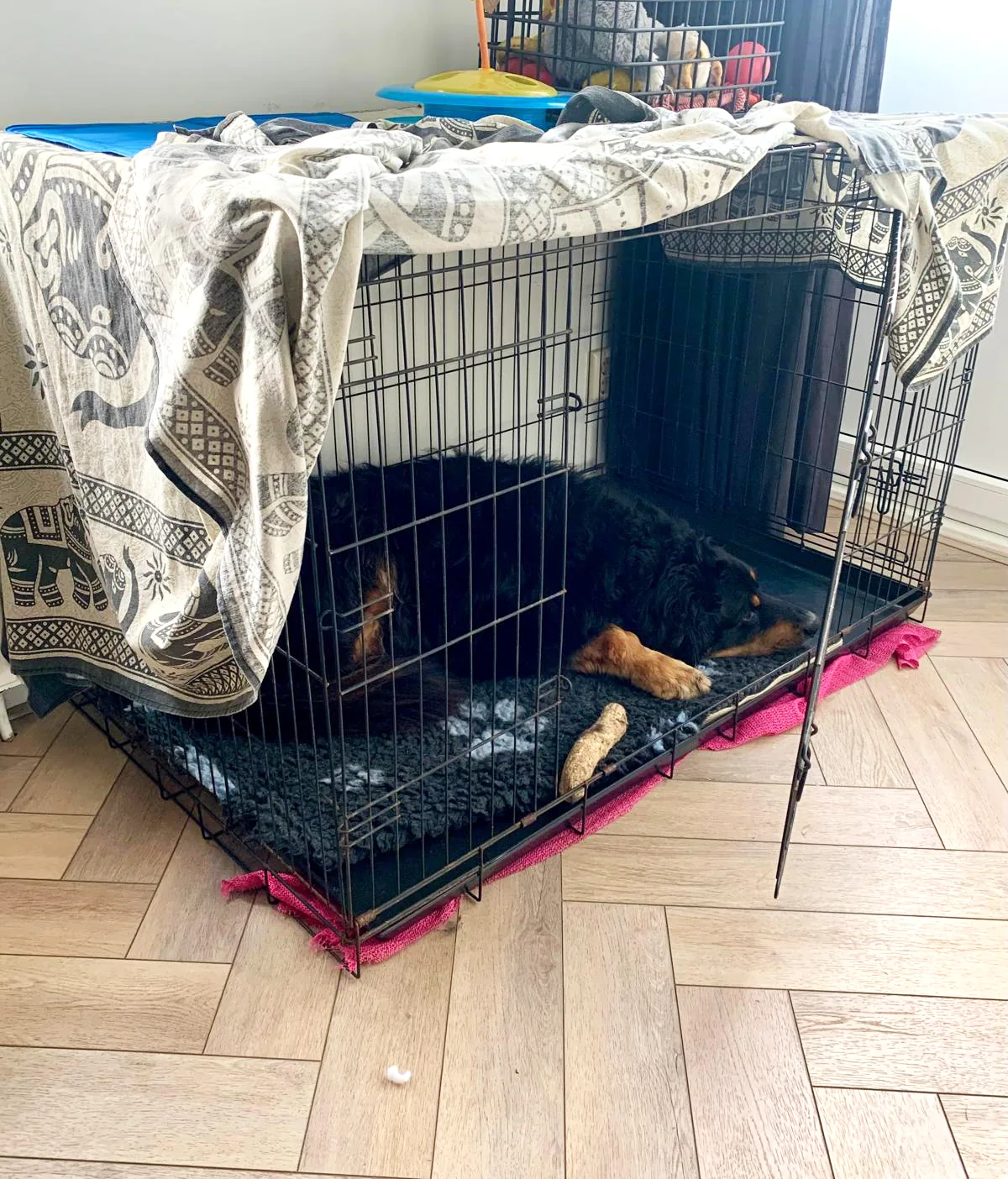
Do you have a puppy? Then this is not the right explanation. With a puppy you build the crate into his day from the start, and there pushing on does work. Read Crate training a puppy.
First work out what is going on
There are two kinds of dogs who will not go in the crate, and they do not ask the same thing of you.
The first simply does not know the crate yet. He finds it exciting, protests for a bit, and then gets used to it fairly quickly. The second has had a bad experience with it. He does not get used to it on his own, because to him the crate is not an unfamiliar place but a place with a memory.
You hear the difference in the way he cries. If there are pauses in between, he is calling you. He can still settle himself and it passes. If there is not a single pause, it is not calling any more but panic, and he will not get out of that under his own steam.
Besides crying without pauses there are more signs of real panic: he tries to work his way out, he pants or drools, he wrecks the crate, or he pees or poos in it while he is perfectly house-trained. If you see that, do not carry on. Pushing through then is not brave but harmful.
The second difference is time. A dog without a bad experience moves forward by the day. If you still see the same picture after a week, you do not have a dog who needs to get used to it, but a dog who needs something repaired.
What you never do
- Push him in. Never. Not even a little nudge with your knee, not even when he is already half in. Anything he does not choose himself makes the crate a place where things are done to him.
- Close the door and sit it out. With a puppy, or with a dog who only needs a little getting used to, that can work. With a dog who has had a bad experience it works exactly the wrong way: you confirm what he was afraid of.
- Use the crate as punishment. Every hour you put into building it up afterwards is then thrown away.
- Take him out while he is crying. That teaches him crying opens the door, and he learns that in one go.
Luring him with a treat is fine, and with a dog who only finds it exciting that is exactly the way to do it. Toss a treat into the crate, let him settle in there, give him the treat and then calmly close the door. If he still finds the crate too much to go in by himself, you are too early. Then you start somewhere else entirely.
The crate stops being an obligation
This is the turning point. You do not want him going in because he has to, you want him to choose it. So for a while you ask nothing at all.
The crate is open and stays open. Fix the door so it cannot swing shut and startle him.
Throw good things in through the day while he is not looking. That is how he learns to check his crate: something appears there out of nowhere. Him discovering it is exactly the point, because then it is his discovery and not your exercise.
Feed him in the crate. Food is the best thing that happens all day, and everything that happens there makes the crate worth more.
If he feels shut in the moment he goes in, put a pen around it or put the crate in a room you can close. He is still in his own spot, but the crate itself is no longer a trap. With Coco that was the difference: not having to go into the crate, but being allowed to choose it.
And then you wait. You do nothing, you ask nothing, and you wait until he lies down in the crate by himself and settles there. That is the moment you may go on, and not a moment earlier.
Only then does the door close
Start small. A couple of minutes, no more. The next day a couple of minutes longer. You build in steps so small he barely notices them.
Only take him out when he is quiet. Do it while he is crying and you have taught him that crying opens the door, and he learns that in one go.
But the best thing is to be ahead of the crying. If you know he started after three minutes yesterday, take him out after two today. If you hear him wake up and it is still quiet, go straight away. Do not wait to see how it goes. Wait too long and the crying starts, and then you have to wait for a pause before you can get him out. Then you are waiting instead of training.
Every time he comes out while he is still calm, the crate gets a little better. Every time he comes out after half an hour of crying, a little worse. Short and good is worth more than long and hard.
During the day, an adult dog who likes his crate can be in it for about three hours. A full working day is not an option, not even when it is going well.
At night it is different. He sleeps through then, so he can be in there longer. If he wakes up and needs to go out, you simply go.
Where he sleeps in the meantime
As long as the crate cannot be closed, he does not sleep in a closed crate. Two places work: a pen around the crate, or a separate room that is safe. In both cases the crate is open and he may go in himself.
That way he still has a place of his own, without the crate being the place where he gets shut in. And you get some sleep too, which you need more than you think.
If there is no progress after a few weeks
Then the question is not how to train harder, but whether the crate is the right place for this dog.
Look at where he can do it. Can he settle outside the crate? Do you have a room where he can safely be alone, without hurting himself or your house? Then do that. A dog lying calmly in a room is further along than a dog sitting neatly in a crate because he has to.
At that point you have two roads, and training harder is not one of them. Either you force nothing at all for now and simply keep making the crate nicer, without ever closing the door. Or you get help from someone who can see your dog.
If he hurts himself trying to get out, you do not wait those few weeks. Then you stop with the crate right away and you get help.
With Coco it went that way in the end too: she found her rest better outside her pen. That part of her story is still to come.
Frequently asked questions
How long does it take before my dog likes his crate?
That varies enormously, and it depends on what he has been through, how old he is and what kind of dog he is. One dog is lying in it after a week, another walks in by himself only after a month.
So do not look at the calendar, look at the direction. A dog who at first would not even come near the crate and a week later walks past it or sniffs it is showing progress. That is exactly what you want to see. If you see no change at all over a few weeks, that is something else, and then the question is whether the crate is the right place.
What do I do if my dog cries the moment I leave the room?
That is common and it comes with the territory. He is calling you. Where are you going, can I come. Listen to the pauses here too: if they are there, he can still settle himself and it will fade.
Watch out for one thing though. If he does this when he is loose in the house and you walk out of sight as well, then it is not about the crate but about being alone. That is a different problem, and a crate does not solve it. It usually makes it worse, because now he cannot even come and find you.
Does covering the crate with a blanket help a fearful dog?
For one dog it does. Dark means less to see, and less to see means less reason to stay awake.
For another dog the blanket becomes a job. He pulls it in and shreds it, and that is not just a waste but dangerous: pieces of fabric can get stuck in his gut. In that case take away whatever he shreds, and offer it again now and then to see whether it works yet.
Do that calmly. If he starts shredding, say nothing, walk over quietly, take it away without eye contact and walk off again. You do not want shredding to become a way of making you come.
Either way, leave one side of the crate open so air and light can get in.
Can my dog's crate be closed at night?
Only if your dog can already handle it. If you are still building it up, do not do it. A night shut in while he is not ready for it during the day works against everything you are building up in the daytime. It does not slow you down, it sets you back.
Should I get rid of the crate if my dog will not go in?
You may, and sometimes it is the best choice. If you see no progress at all, or you notice your dog settles much better outside the crate, that crate does not need to be there.
But you can also simply leave it standing and ask nothing more of him. Keep throwing kibble in and feed him in there, weeks on end, until you are sure he no longer finds the crate scary and goes to have a look now and then. Every positive time counts, even if you never get further than that.