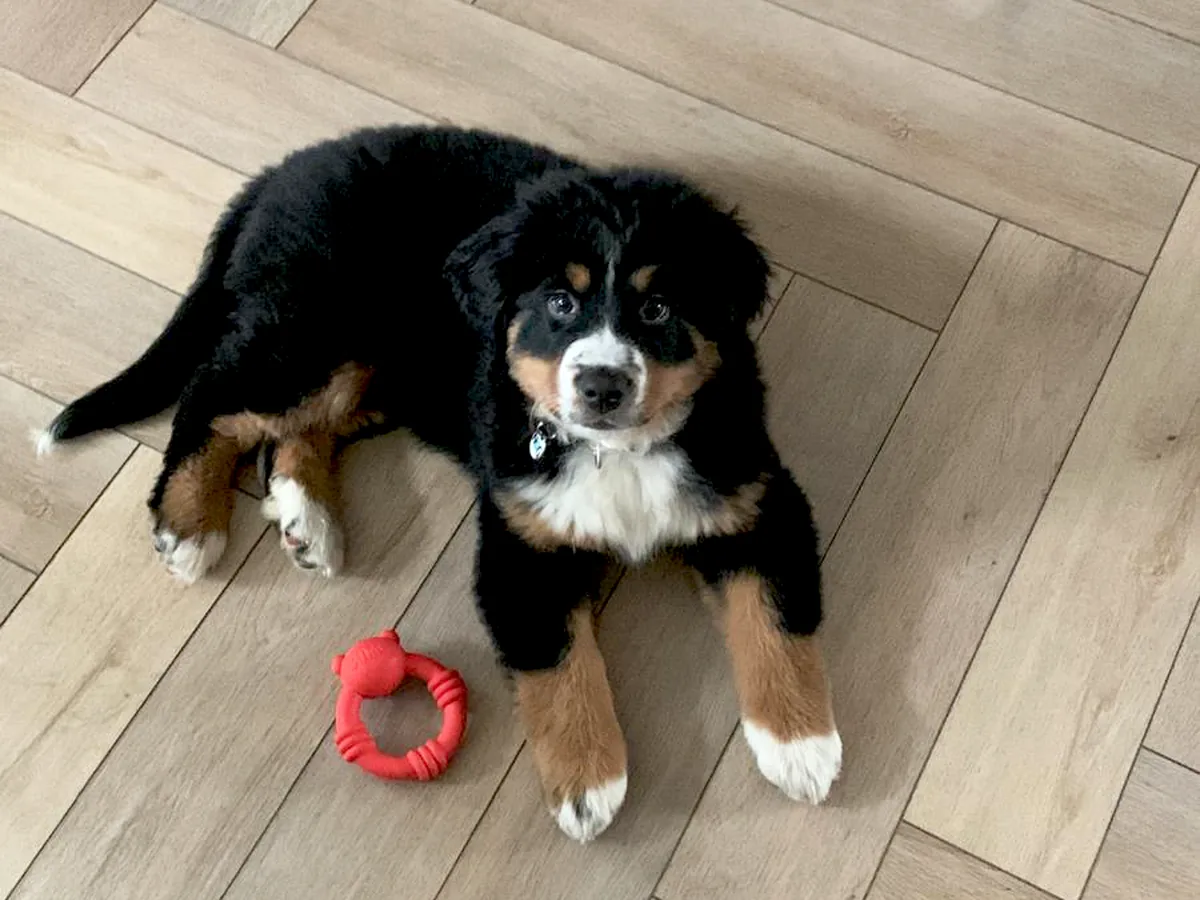
A puppy who knows what his day looks like has far less to work out. He knows when something happens, so he does not have to keep asking whether something is about to happen. That saves him tension, and saves you a dog who circles you all day.
Below is the schedule everything else leans on. Fill in your own times, pick how old your puppy is, and print it if you want it on the fridge.
Your schedule
Daily schedule for a puppy
07:00 to 23:30, puppy of 3 monthsGo to the same patch of grass every time, so he recognises it as the place where he goes. And only start the walk once he has been, otherwise he learns to hold it in order to get that walk.
Nothing after five minutes? Carry him inside and put him in his crate. Ten minutes later you try again.
Only give him his food once he is calm and ready to lie down. And no playing or walking after eating: a quiet toilet break is fine, running is not.
Keep part of his daily portion aside to train with. Then you do not need treats and he does not get too much.
This schedule is a guideline, not a law. Every puppy is different: look at your own dog and at what he shows you. If he wakes earlier, is done in after a walk, or asks to go out himself, you follow him and not the schedule. The walking times are a ceiling and not a target: how much your dog needs depends on his breed and his energy, and pottering about and sniffing at his own pace does not count as walking.
What happens when you let it go
The schedule is not a goal in itself. It is what gives your puppy something to hold on to, and you see that the moment it disappears.
- He does not know when he is allowed to go. So he does not hold it, because why would he. More accidents, and slower house training.
- He does not know when you are going to play. So he asks himself, over and over, and you are the one who then does or does not join in. That is how he learns that asking for attention works.
- He does not learn how to be bored. So he wants something to do all day. That is the hardest one to undo later.
Toilet breaks always happen in the same spot
Pick one spot, a fixed patch of grass for example, and go there every time. He will start to recognise it as the place where he goes, and that makes it a lot easier for him.
More importantly: only start the walk once he has been there. Walk straight on and he learns something you do not want: if I hold it, we go for a walk. Then he will hold it on purpose, including at moments when you had no intention of walking at all.
If nothing comes after five minutes, carry him inside and put him in his crate. Ten minutes later you try again. That way the spot stays connected to going to the toilet and not to hanging around.
Sleep is the biggest part of the day
A young puppy sleeps 18 to 20 hours a day. That is not a luxury, that is what he grows on and how he processes what he has been through.
A puppy who sleeps too little does not get calmer but busier. He bites harder, listens worse and cannot stop. Doing more is then exactly the wrong move, and sleep is the answer.
If he will not go to sleep while it is sleep time, it is usually not about tiredness but about the place. How you build that up is in Crate training a puppy. No crate? Then give him one fixed resting place with as little distraction as possible, where he can safely lie alone without being able to eat something that is bad for him.
Walking grows with him, and no faster than that
The older he gets, the longer he can walk. As a guideline I use about five minutes per month of age, a few times a day. So a three month old puppy walks about a quarter of an hour at a time.
Read that as a ceiling and not as a target. A ten month old dog does not have to walk for an hour because he is allowed to, that depends on his breed and on how much energy he has. Pottering about and sniffing at his own pace is something else than walking, by the way: that is good for him and does not count towards those minutes.
Walking on too long is where it goes wrong: a puppy who has to keep up for too long comes home not tired but wound up.
There is a physical side to it as well. His joints and growth plates are not finished yet, and too much and too long is exactly what wears on them. For large breeds that counts double, and they keep growing the longest.
Do not let your puppy do stairs, certainly not if he is going to be big. In large breeds up to three months of age, a link has been found between using stairs and a higher risk of hip dysplasia. Carry him, or put a gate in front of them. What is good for his hips: pottering about off lead on soft, uneven ground, at his own pace.
Nothing happens after a meal
Look at the schedule and you will see it: food, and then sleep. That is not a coincidence.
You do not want playing or walking on a full stomach. In dogs the stomach can twist when movement comes on top of a full belly, and that is life threatening. Cornell lists exercising soon after eating as one of the risk factors. The risk is highest in big dogs with a deep chest, but it is not something to experiment with in any dog.
That is why the meals in this schedule always sit just before sleep. A quiet toilet break after eating is fine, but keep it quiet: no running, no wrestling, no visitors winding him up.
In the beginning you train a lot, and treats add up fast. So take his portion for that day and keep part of it aside to train with. What is left goes in his bowl, even if that is a little less. That way he does not get more than he needs, and every exercise is still rewarded.
What you teach your puppy first, and how you go about it, is coming in a separate explanation about the first exercises. It is not there yet.
Doing nothing is part of it too
At least once a day, nothing happens. Outside the crate, just lying somewhere while you do something else. Indoors on his mat or outside in the garden, it does not matter.
Being bored is the point here. A dog who only ever learns that there is always something going on will come to expect that, and in a working dog that is a problem you drag along for years.
How you build that up with a dog who cannot do it by himself is coming in a separate explanation about doing nothing. It is not there yet.
Socialising belongs in the free time
You do not need a separate block for it. During the walk or in the free time you simply go and stand somewhere where something passes now and then: at the edge of the pavement, by a cycle path, on a bench near a small square.
And watch what socialising is and is not. It does not mean he has to greet every dog and every person. It means he comes to find it normal that people and dogs walk past and that he does not have to do anything about it. That is the exact opposite of saying hello to every dog.
How you build that up step by step, and what you do when he finds it too much, is coming in a separate explanation about socialisation. It is not there yet.
Training belongs in the free time
Training does not need a block of its own either. You do it in the time the schedule sets aside for playing and free time, with the food you kept aside.
Do keep it short. Ten minutes at a time is enough, one to three times a day. A puppy cannot concentrate for longer than that in one go, and what you do after that adds little. Rather stop while it is still going well.
Chewing and free time
Chewing does not need its own place in the schedule, it falls under playing and free time. It is one of the best ways to fill that time though, because chewing makes most puppies calm rather than busier.
How you let the schedule grow
Download the schedule again as soon as your puppy is a month further. The times adjust by themselves: longer walks, longer awake, shorter naps.
You do not have to take that step in one go. If you see he is ready for it, stretch it a little already: outside a bit later than the week before, awake a bit longer. Then the move from one month to the next is not a jump but a next step.
When it does not work out
A day when the schedule falls apart breaks nothing. Visitors, a vet appointment, getting up late once: that comes with the territory.
Just pick it up where you left off. The order matters more than the clock: waking up, outside, doing something, and then sleep again. As long as that round stays standing, it falls back into place by itself.
Frequently asked questions
Do I have to wake my puppy up for the schedule?
No. Just wait until he wakes up by himself and then pick the schedule up where you left off.
The order matters more than the clock: waking up, outside, doing something, and then sleep again. If he sleeps half an hour longer, the rest of your day shifts half an hour and nothing else happens.
How long can I leave my puppy alone?
That depends on his age, and above all on how much he has practised. A puppy who has never done it does not manage a few hours just because his age says he should be able to.
Build it up quietly. Walk out of the room now and then and come back after a minute, without making anything of it: no goodbye, no greeting. You stretch that a little at a time, and it grows into hours by itself.
How you build that up step by step is coming in a separate explanation about learning to be alone. It is not there yet.
What do I do if my puppy will not sleep during the day?
In the beginning he may well put up a bit of a fight. Wait it out calmly. As long as nothing happens, he will end up going to sleep.
If it keeps going, it is usually not about tiredness but about the place.
How you turn the crate into a place he chooses himself is in Crate training a puppy.
How do I fit my puppy's schedule around work?
A puppy cannot be home alone for a whole working day. Neither can most adult dogs, for that matter. Eight hours in the crate or alone in the house is simply not an option.
So make sure there is someone who can let him out in between. Or take him to a sitter. Give them your own schedule, then his day carries on the same way there and he keeps his structure in that place too.
When does a puppy go from three meals to two?
Usually around six months. The line most vets hold to, and the one the AKC sets out: four times a day until about four months, then three times a day, and from about six months twice a day. The schedule above does that by itself as soon as you change the age.
Do not make that step overnight. Move the midday meal over a week or two until it sits next to breakfast or dinner, and then drop it. What comes off goes onto the two meals that are left, because he still has to get the same amount over the day.
Large breeds keep growing longer, and there it matters even more not to cut back too fast. If you are in doubt, ask your vet.
Does my puppy still need to go out at night?
He does not have to. Get him used to a whole night as soon as you can, then that simply becomes normal for him.
If that really does not work, take him out once a night, and do it a little later each time. That way it shifts towards the morning by itself until he sleeps through.